You’re deep into a mountain descent when the trail drops from an open ridgeline beneath dense tree cover. In seconds, the light changes from harsh midday glare to deep shade. Your eyes begin to adjust. Your sunglasses don’t.
This isn’t an unusual moment in cycling, trail running, or mountain sports. Outdoor light can change faster than fixed-tint eyewear can accommodate, especially on routes that move repeatedly between exposed terrain and tree cover. Photochromic lenses respond automatically, but a full transition can take tens of seconds. Fixed-tint lenses don’t change at all.
The POVEC C1 switches between two tint states in under one second. That difference—between waiting for a lens to react and choosing the tint yourself—is what this article is about.
The Problem: Light Changes Faster Than Your Eyes
What Is Photostress and Why It Matters at Speed
Photostress is a clinical term used to describe the temporary reduction in visual performance that follows exposure to intense light. After bright light overwhelms the retina’s photoreceptors, vision needs time to recover.
Outdoor athletes encounter a related challenge when moving quickly from bright sunlight into shade. Your eyes begin adapting immediately, but the process is not instantaneous. For a short period, contrast may feel reduced and terrain details can be harder to distinguish.
At walking speed, that may be little more than an inconvenience. At cycling or trail-running pace, the same transition demands more attention. Roots, loose surfaces, changes in grade, and other details continue approaching while your vision adjusts.
Recovery time varies from person to person and depends on factors including light intensity, age, and the testing method used. The practical point is simpler: visual adaptation takes time, while the terrain keeps moving.
Eyewear cannot eliminate the eye’s natural adaptation process. What it can do is avoid adding unnecessary delay by allowing the lens tint to change more quickly.
Real Scenarios: Tree Cover, Cloud Cover, and Sudden Glare
Changing light appears in several familiar outdoor situations:
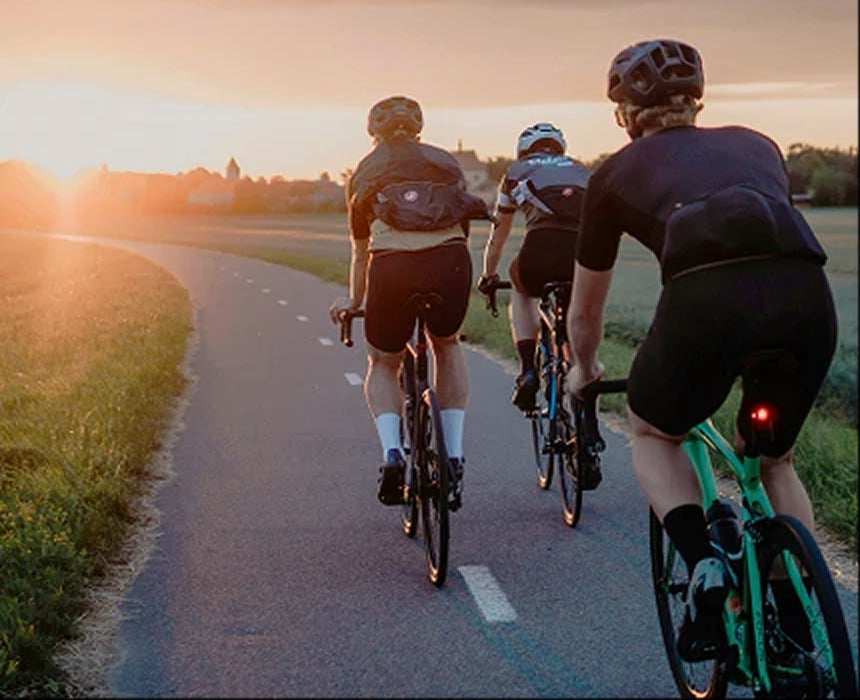
- Tree cover on road descents: A route can alternate between exposed sunlight and heavily shaded sections within seconds. A dark lens that feels comfortable in the open may reduce visibility once the road moves beneath the trees.
- Forest trails: Singletrack often moves through patches of direct sunlight and deep shade in rapid succession. The variation is constant, irregular, and difficult to predict before the ride.
- High-altitude glare and cloud cover: At elevation, bright reflected light can quickly give way to flatter conditions as clouds move across the sun. One fixed tint may not suit both environments equally well.
In each case, the question isn’t whether the light will eventually stabilize. It’s whether your eyewear gives you a practical way to respond when it doesn’t.
Why Photochromic Sunglasses Struggle with Rapid Light Changes
Photochromic Lenses: Why the Wait Matters
Photochromic lenses contain light-sensitive compounds that react to ultraviolet exposure. As UV levels increase, the lenses gradually darken. When UV exposure falls, they slowly return to a lighter state.
It’s an elegant passive system, but it has two limitations in fast-changing outdoor environments.
The first is speed. A photochromic transition typically takes tens of seconds, and the return to a lighter state often takes longer than the initial darkening. If a rider moves suddenly from full sun into tree cover, the lens may remain darker than desired while the eyes are already trying to adjust.
The second is temperature sensitivity. Photochromic performance changes with temperature, and colder conditions can slow the clearing process. That matters during winter rides and at higher elevations, where both temperature and light can change quickly.
Photochromic sunglasses are useful when the environment changes gradually. They are less suited to situations where the athlete wants an immediate, deliberate change in lens tint.
Fixed Tint: One Setting, No Flexibility
The other common option is a fixed-tint or interchangeable lens system. You might choose CAT 2 for mixed daylight and CAT 3 for stronger sun, then carry a second lens in case the weather changes.
In practice, most athletes don’t change lenses in the middle of a ride or run. Doing so means stopping, removing the glasses, handling the replacement lens, and finding somewhere to store the one you just removed.
So you make a decision before leaving and live with it. The lens may be right for the exposed climb but too dark beneath the trees, or comfortable under cloud cover but not dark enough when the sun breaks through.
The problem isn’t that fixed lenses perform poorly. It’s that outdoor conditions rarely stay fixed with them.
The POVEC Approach: 1-Second Swipe Control
Two Tint Modes (CAT 2–3) for Changing Daylight
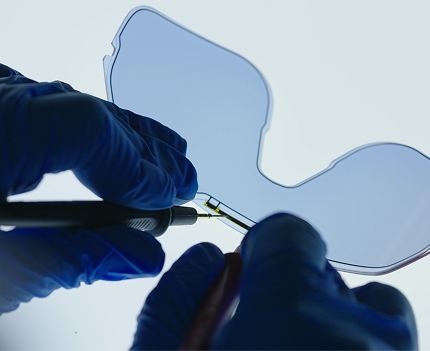
The C1 uses solid-state electrochromic lens technology based on the same material science deployed across more than 20 vehicle models and experienced by over 300,000 automotive users.
It provides two distinct tint states:
- CAT 2—Light Tint: Designed for overcast skies, tree cover, and mixed daylight conditions. It allows more visible light through the lens when full CAT 3 darkness isn’t needed.
- CAT 3—Dark Tint: Designed for bright sun, exposed terrain, and stronger daytime glare.
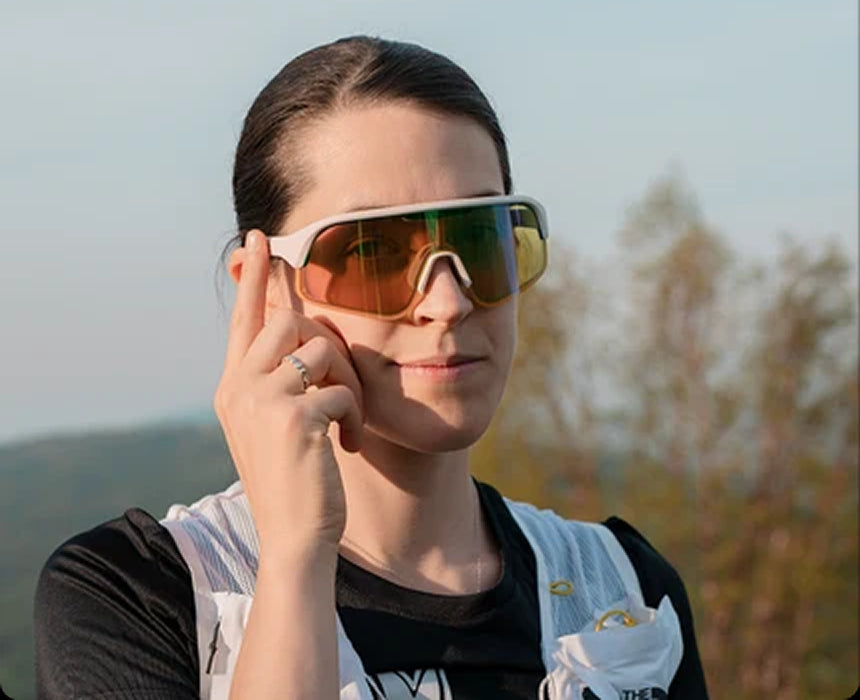
A swipe across the logo on the outside of the right temple triggers the change. Swipe forward to make the lens lighter or backward to make it darker. The full transition completes in under one second.
There is no lens to replace and no need to wait for UV exposure to trigger a gradual response. You choose the tint that fits the conditions in front of you.
C1 is intended for daytime use. It should not be used for night driving, twilight conditions, or other environments where available light is insufficient.
User Control vs. UV Dependency
The core difference between electrochromic and photochromic technology isn’t only speed. It’s control.
Photochromic lenses respond to UV exposure. The wearer cannot choose exactly when they darken or clear, and the response may vary with temperature and the surrounding environment.
C1 responds to the wearer. The tint changes when you swipe the temple, whether you are in direct sunlight, beneath tree cover, or behind a vehicle windshield during daytime driving.
Because the electrochromic system is electrically controlled, it does not depend on UV light to activate. That gives the wearer a consistent way to move between CAT 2 and CAT 3 based on the conditions they can see ahead.
Field-Tested in Real Mountain Conditions
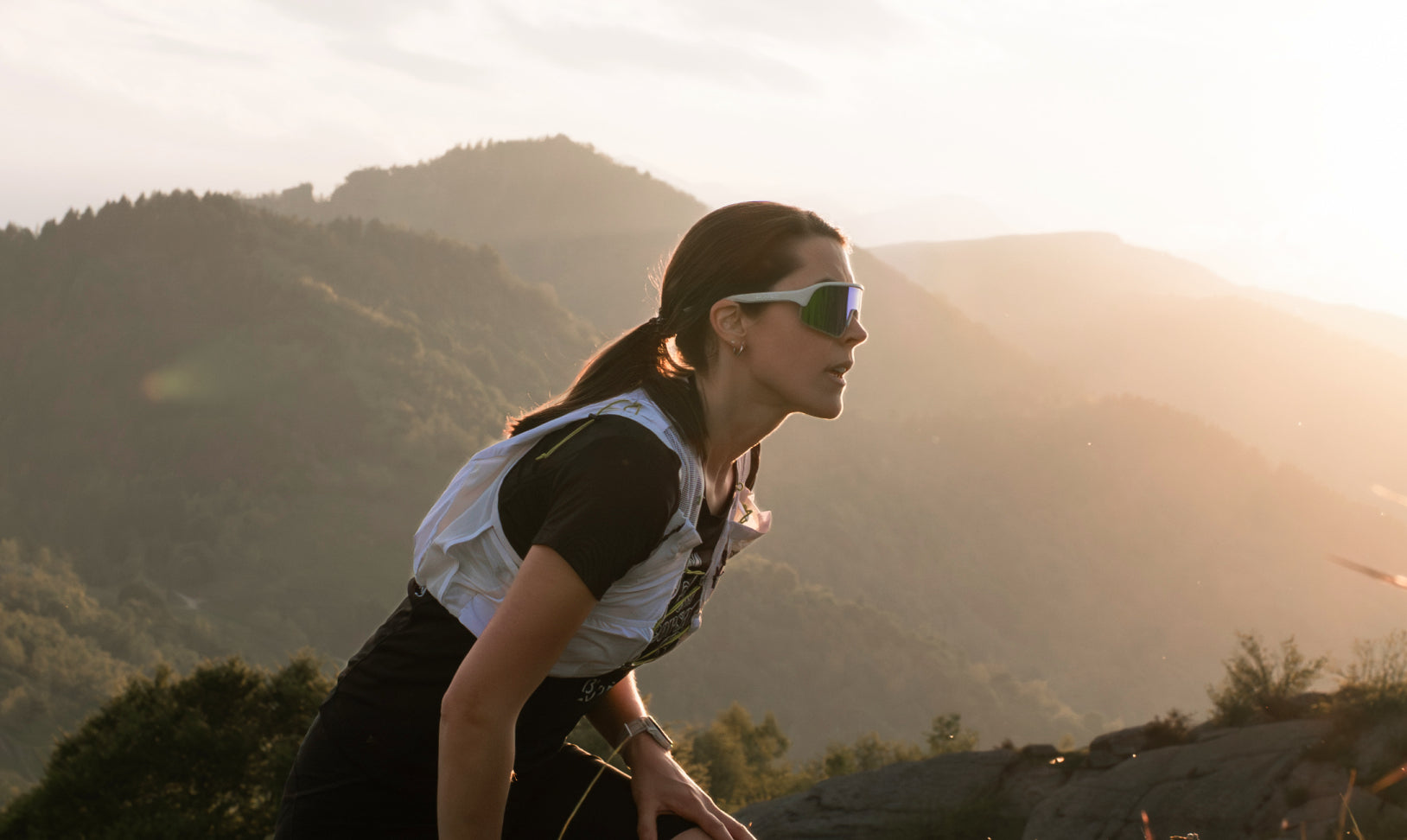
During development, the C1 was tested by cyclists and mountain athletes in demanding outdoor environments, including high-altitude conditions at Val d’Isère.
One situation came up repeatedly: the sudden change in light during a descent. Riders often move from open exposure into tree cover before a passive lens has time to respond. With C1, the tint can be changed with a swipe on the right temple whenever it is safe to do so.
The frame weighs approximately 36 grams, keeping it in line with premium conventional sports eyewear. Its IP65 rating provides protection against dust and water spray, making it suitable for sweat, rain, and changing outdoor weather.
Battery life reaches up to 28 days based on four hours of daily use and approximately 40 tint adjustments per day. A full charge takes about two hours through USB-C, so charging doesn’t need to become part of the daily routine.
The advantage of sub-second tint control is straightforward. It reduces the time the lens remains darker or lighter than the wearer wants when daylight conditions change quickly. It does not replace the eye’s natural adaptation process, but it gives the athlete immediate control over one important part of the visual experience.
For outdoor athletes accustomed to choosing one lens and hoping the conditions cooperate, that control can make a meaningful difference.
See the POVEC C1 for yourself at povecoptics.com.