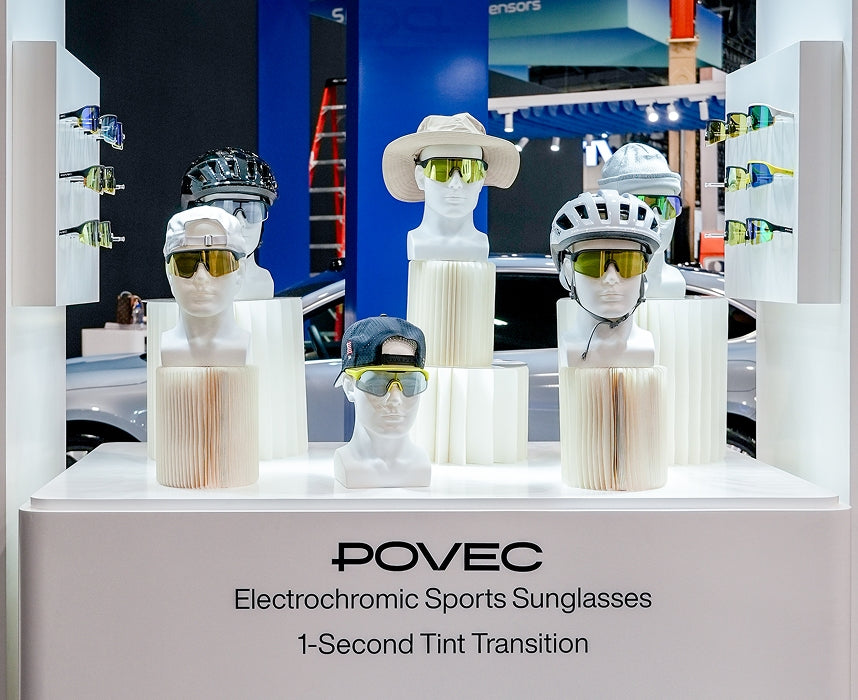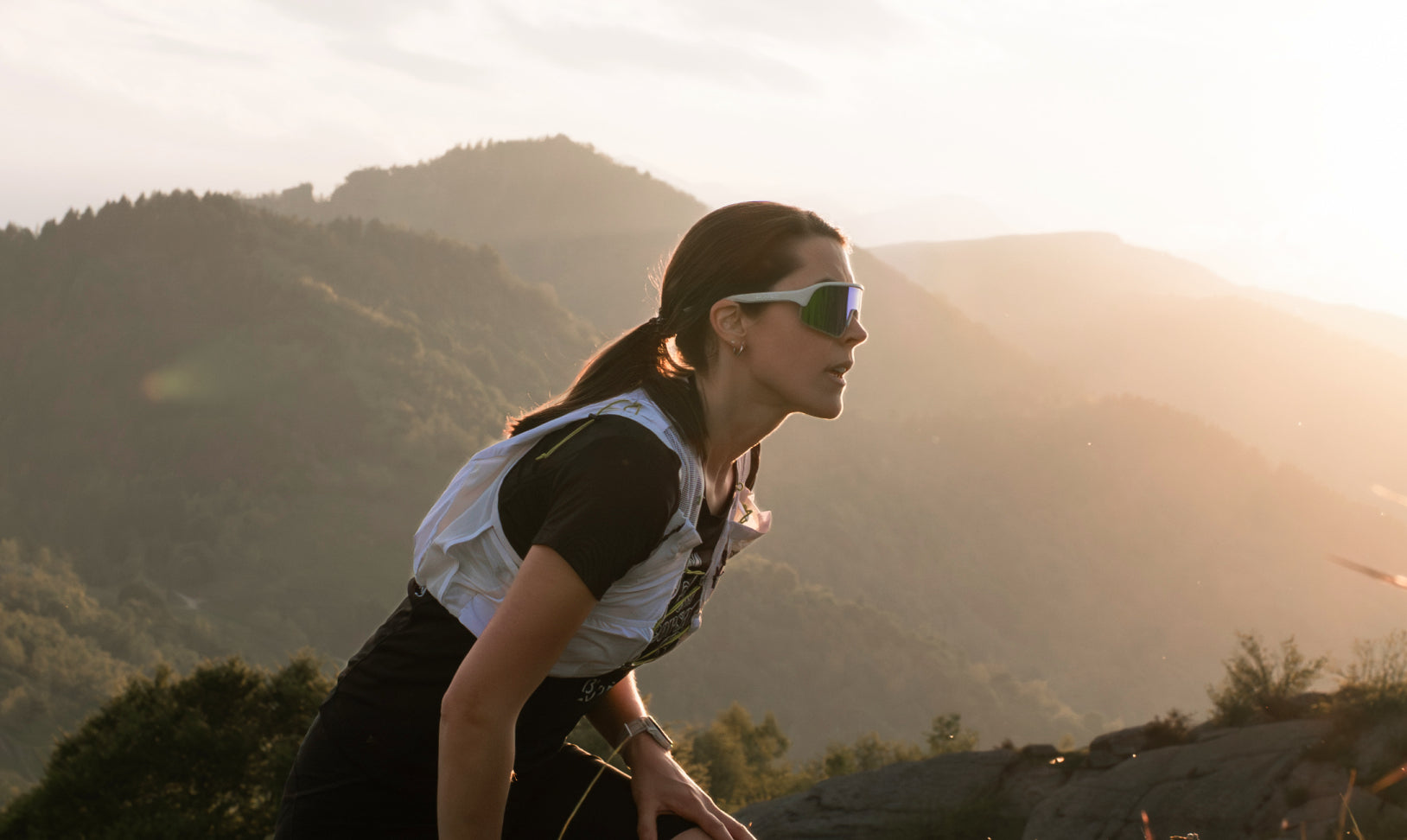

There’s a ritual most outdoor athletes know well. The night before a long ride or run, you lay out your kit: clothing, nutrition, hydration—and maybe two pairs of sunglasses. A darker pair for full sun. A lighter pair for cloud cover and shaded sections.
You choose the one that seems right, leave the other at home, and hope the forecast holds. Then the weather does what weather does.
The multi-lens problem isn’t new. For years, athletes have treated it as an unavoidable part of being prepared for changing light. Interchangeable lenses help, but changing them mid-ride or mid-run is rarely practical. Photochromic lenses offer another option, but they can take tens of seconds—or longer—to adjust. That’s often too slow when you’re moving quickly between open sunlight and deep shade.
We built the POVEC C1 around a different idea: one frame, two tint states, and control in under one second. At just 36 grams, it feels like conventional performance eyewear, but a swipe on the temple lets you move between a lighter CAT 2 tint and a darker CAT 3 tint without stopping.
The Multi-Lens Problem: Why Athletes Carry More Eyewear Than They Should
Why Athletes and Outdoor Users Carry Multiple Pairs
Light conditions during outdoor sports rarely stay consistent. A road ride can move from cloud cover to dappled tree shade and then onto a fully exposed climb within a matter of minutes. Trail runners and mountain bikers encounter even faster transitions as the route moves in and out of the woods.
No fixed-tint lens handles every one of these conditions equally well. A CAT 3 lens is a solid choice for bright sun and exposed terrain, but it can feel too dark under heavy tree cover. A lighter CAT 2 lens works well in overcast and mixed daylight, but may not cut enough glare when the route opens up.
Photochromic sunglasses are designed to cover a broader range by reacting automatically to UV light. The tradeoff is speed. Changing from light to dark—or back again—typically takes tens of seconds and may take longer depending on temperature and other conditions. That works when the light changes gradually. It’s less effective when every turn in the trail brings a different level of exposure.
As a result, many athletes own multiple pairs of sports sunglasses or several interchangeable lenses for different weather, seasons, and activities. The problem isn’t a lack of options. It’s having the right option on your face when the conditions change.
The Cost and Hassle of Swapping Lenses
Interchangeable lens systems reduce the number of frames you need, but they don’t eliminate the interruption. You still have to stop, remove your glasses, pull out a spare lens, and make the swap without dropping or smudging anything.
In gloves, rain, dust, or cold weather, that small task becomes even more awkward. Most athletes simply choose a lens before heading out and stick with it, even when the conditions no longer match.
Spare lenses also need to be carried and protected. That means another case or pouch taking up space in a jersey pocket, running vest, or hydration pack.
POVEC C1 removes the lens change altogether. When the light changes, you swipe the right temple and the lens switches tint in under one second. There’s no need to stop, reach for another lens, or wait for the tint to react on its own.
CAT 2 to CAT 3: One Pair, Two Modes
Light Tint Mode (CAT 2): Overcast and Mixed Conditions
CAT 2 is the lighter of the C1’s two tint states. It’s designed for overcast skies, intermittent shade, and mixed daylight—the conditions common on wooded trails, cloudy rides, and routes where the level of exposure keeps changing.
The lighter tint allows more visible light through the lens, helping preserve contrast and terrain detail when full CAT 3 darkness isn’t necessary. You still get UV400 protection, along with coverage from wind, dust, and trail debris.
With C1, CAT 2 isn’t the compromise you’re stuck with for the rest of the day. It’s simply the tint that fits the current stretch of the route. When you move back into stronger sun, a swipe takes you to CAT 3.
Dark Tint Mode (CAT 3): Bright Sun and Strong Glare
CAT 3 is designed for bright daylight, exposed roads, open trails, and high-glare conditions. It reduces visible light transmission to provide greater comfort when the sun is at its strongest.
The C1’s solid-state electrochromic lens reaches its darker tint in under one second. Unlike photochromic sunglasses, it doesn’t rely on UV exposure to trigger a gradual transition. The change happens when you choose, based on the conditions you can see ahead.
That control matters when exposure changes quickly. You can switch to CAT 3 before leaving the trees for an open climb, then return to CAT 2 when the route moves back under cover. There’s no need to predict the entire day’s weather before you start.
Built for All-Day Performance: 36g Frame, IP65 Rating, 28-Day Battery
36g Weight, TR90 Frame, IP65 Water Resistance
Electronics only make sense in performance eyewear if they don’t get in the way. That’s why C1 was developed first and foremost as a piece of outdoor gear.
The frame is made from TR90, a material widely used in performance eyewear for its balance of flexibility, durability, and low weight. The complete pair weighs approximately 36 grams, keeping it in line with premium conventional sports sunglasses.
C1 also carries an IP65 rating for protection against dust and water spray. It’s built to handle sweat, rain, and the everyday exposure that comes with riding, running, and spending long hours outside.
28-Day Battery Life at 4 Hours Daily Use
The solid-state electrochromic system uses power only when needed. Based on four hours of daily use and approximately 40 tint adjustments per day, C1 can run for up to 28 days on a single charge.
There’s no companion app, charging case, or nightly charging routine. Fully open the temples to turn the glasses on, swipe the right temple to adjust the tint, and fold the temples when you’re finished.
Charging is handled through USB-C and takes approximately two hours. For most athletes, it’s something to think about once every few weeks—not before every workout.
Who Should Use Adaptive Tint Sunglasses?
Adaptive tint sunglasses are most useful for people whose activities regularly take them through different daylight conditions. That includes road cyclists moving between exposed roads and tree cover, mountain bikers riding in and out of the woods, trail runners crossing mixed terrain, and hikers dealing with shifting cloud cover and elevation.
C1 is also a practical option for commuters and daytime drivers. Traditional photochromic lenses may not darken fully inside a vehicle because many windshields block much of the UV light that activates them. With manual tint control, the wearer decides when the lens should be lighter or darker.
Unlike automatically adaptive eyewear, C1 puts that decision in your hands. It responds to a swipe in under one second, so you don’t have to wait for the lens to catch up with the environment.
If changing daylight is a regular part of how you move outdoors, C1 gives you a simpler way to manage it: one pair of performance sunglasses, two useful tint states, and instant control while you’re on the move.
Simplify your kit. Discover the POVEC C1 at povecoptics.com.